
How Long Do Aluminum Pontoons Last?
How Long Do Aluminum Pontoons Last?
Aluminum pontoons are built to resist the failure modes that shorten a pontoon boat’s life, such as wood rot, corrosion, and loosening fasteners. A welded, uni-body aluminum deck, an aluminum mounting surface, and marine-grade vinyl rated past 100,000 double rubs on the Wyzenbeek Abrasion Resistance Test all contribute to long-term durability compared to wood-decked or riveted alternatives.
Construction Factors Behind Durability
Longevity in an aluminum pontoon comes down to how the deck, structure, and materials are built and joined together:
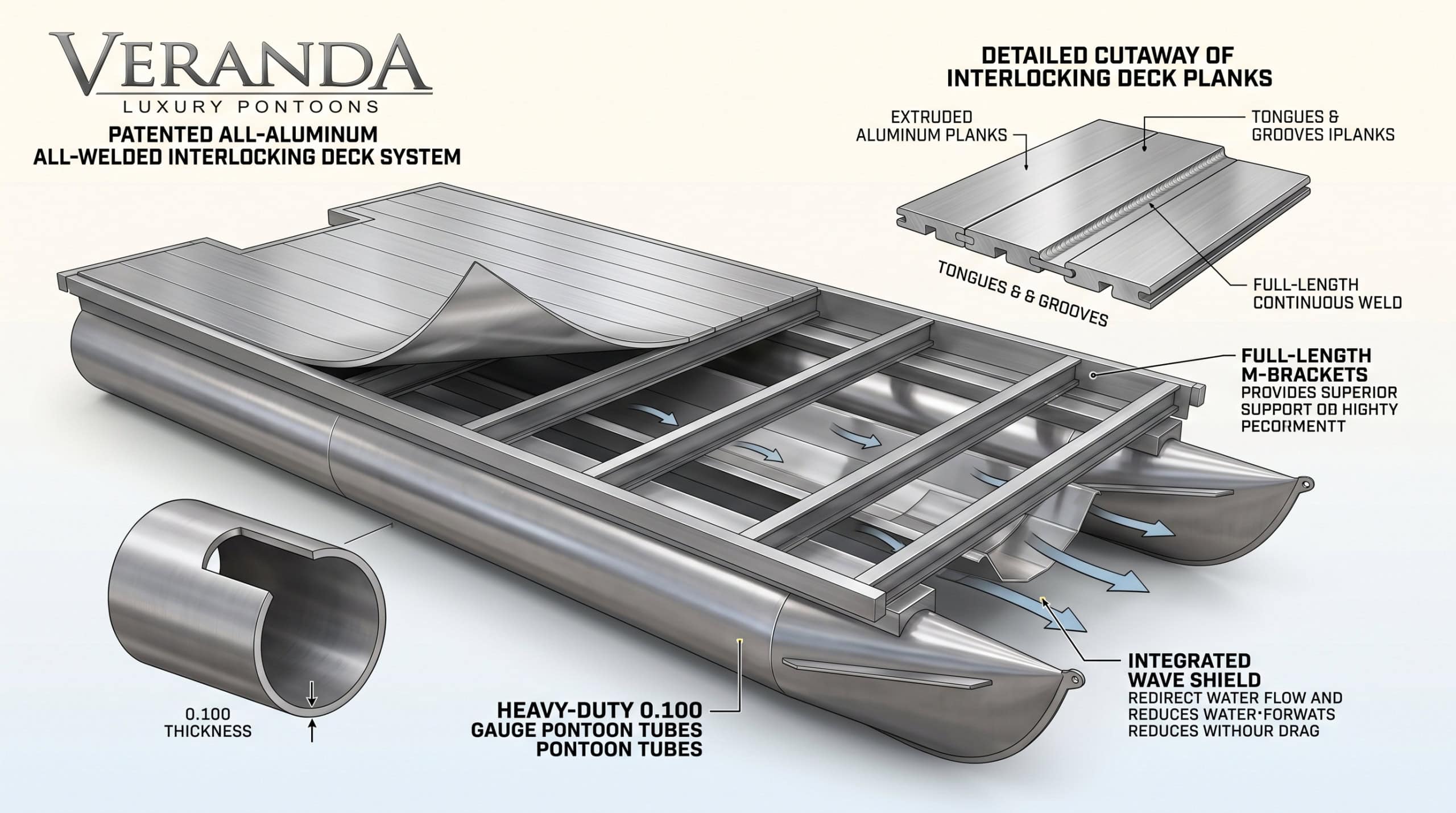
- Patented Extruded Aluminum Plank
- All-Welded Interlocking Deck
- Uni-Body Construction
- Aluminum Mounting Surface
- Integrated Wave Shield
- Marine Grade Vinyl
- Antifungal, UV-Inhibiting Additives
- Wyzenbeek-Tested Abrasion Resistance
Durability & Material Specifications
| Deck Plank Size | 2×6 interlocking aluminum planks |
|---|---|
| Deck Plank Type | Patented extruded aluminum (hollow-chambered) |
| Deck Construction | All-welded, uni-body (planks welded to full-length brackets) |
| Mounting Structure | Aluminum mounting surface |
| Underside Design | Integrated Wave Shield (smooth, obstruction-free) |
| Upholstery Material | Marine-grade vinyl |
| Vinyl Properties | UV-inhibiting, mildew-resistant, antifungal-infused |
| Abrasion Test | Wyzenbeek Abrasion Resistance Test |
| Abrasion Rating | 100,000+ double rubs (#8 cotton) |
| Model Lineup | 5 series, 11 models |
Why Extruded, Hollow-Chambered Planks Matter
Each deck plank is extruded aluminum rather than solid stock, creating hollow internal chambers. These chambers reduce overall weight and allow aeration of the deck surface, keeping it cooler in hot weather. Wood decking, by comparison, absorbs moisture and gains weight over time, contributing to structural breakdown.
Welded vs. Riveted or Screw-Together Decks
Each 2×6 plank interlocks with the next, then is welded directly to brackets that run the full length of each pontoon. This uni-body construction eliminates the flex and noise associated with screw-together decks, and avoids the loosening that occurs over time with riveted or fastened seams.
Material Resistance Over Time
Marine-grade vinyl used in the seating is treated to inhibit ultraviolet light and mildew and is infused with antifungal additives. Independent Wyzenbeek testing shows the material exceeds 100,000 double rubs with #8 cotton, a wear-resistance benchmark well above general industry standards for upholstery longevity.
Frequently Asked Questions
How long do aluminum pontoons last?
Aluminum pontoons are built to resist the failure modes that shorten a pontoon boat’s life, such as wood rot, corrosion, and loosening fasteners. A welded, uni-body aluminum deck, an aluminum mounting surface, and marine-grade vinyl rated past 100,000 double rubs on the Wyzenbeek Abrasion Resistance Test all contribute to long-term durability compared to wood-decked or riveted alternatives.
What makes aluminum pontoons more durable than wood-decked pontoons?
Aluminum pontoons use an all-aluminum deck instead of wood, eliminating the rot, moisture absorption, and weight gain that wood decks experience over time. The aluminum mounting surface also holds fasteners for railing and seating more securely than a wood structure, where fasteners are more likely to break away or loosen.
Is a welded aluminum deck better than a riveted one?
A welded aluminum deck creates a uni-body construction that eliminates flex and noise, unlike screw-together or riveted decks. Welded interlocking planks are joined directly to full-length brackets running the length of each pontoon, producing a single solid foundation rather than a mechanically fastened assembly.
What is the Wyzenbeek Abrasion Resistance Test and why does it matter for pontoon boats?
The Wyzenbeek Abrasion Resistance Test measures how many rubbing cycles, called double rubs, a fabric can withstand before wearing through. Marine-grade vinyl used on aluminum pontoon boats exceeds 100,000 double rubs with number 8 cotton, significantly above industry standards, indicating strong long-term wear resistance for boat seating and upholstery.